The Shining Path by Gustavo Gorriti
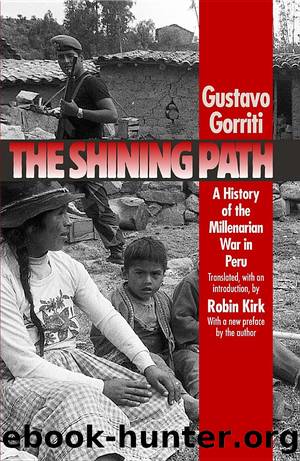
Author:Gustavo Gorriti
Language: eng
Format: epub
Publisher: The University of North Carolina Press
Published: 1999-06-15T00:00:00+00:00
12: The Emergency
At 5 P.M. on Monday, October 12, Civil Guard general Carlos Barreto Bretoneche, chief of the Huancayo subregion, received a telephone call from General Humberto Catter, Civil Guard commander. He was told to travel to Lima, according to military jargon, âwith all due haste.â
Barreto, a relatively young general (he was forty-nine, and had just been promoted that January), realized immediately what was at stake. The order had arrived at a bad moment. He was suffering from severe stomach upset, the type of affliction, unfortunately, that was less than mentionable under the circumstances. Nevertheless, soon after receiving the call, Barreto traveled to Lima accompanied by a police doctor and his intelligence director. He arrived at 4 A.M. and headed for the offices of the Second Police Region, at the Lima Prefecture. There, the head of the Second Region, General Jorge Monge, told him about the state of emergency declaration. Monge also told him that as the chief of the Huancayo subregion, he, Barreto, was to take command of the new emergency zone. He had to travel to Ayacucho within three hours. Written orders would be delivered to him in the airport, as he boarded his airplane.1
At 7 A.M., Barreto found himself at Air Force Base No. Eight with Monge and his assistant, General Héctor Rivera Hurtado. A Sinchi battalion of police trained for special operations was boarding an Air Force Hercules. Logistics officers supervised the loading of equipment. Still pale from the nightâs vigil and his inopportune rumblings, Barreto received his written orders. Under the general title âInstruction Listâ and signed by Minister De la Jara, the orders avoided any hint of military jargon and conferred a decidedly civilian mind-set on the operation.
Only during the brief flight to Ayacucho could Barreto read them for the first time and begin to familiarize himself with the mission he had been assigned and the means he had been given to carry it out.
In the Ayacucho airport, Barreto, already recovering from his illness (no doubt spurred by the seriousness of the responsibility placed on his shoulders), was received by departmental authorities and Ayacuchoâs three police chiefs.
A little later, Barreto led the first emergency meeting in the Ninth Station, which included, along with the police chiefs, the departmental prefect, Marciano Cavero; the Huamanga mayor, Jorge Jáuregui MejÃa; and the commander of Ayacuchoâs âLos Cabitosâ army base. Although Barreto had been given authority only over security matters, for all intents and purposes Prefect Cavero ceded to him all political authority in the area.
Barretoâs âInstruction Listâ indicated that he would receive weapons, transportation, and communications assistance from the armed forces. The army would provide light automatic rifles (FAL) and Unimog trucks to transport troops. The navy would supply radio sets. The air force would lend helicopters. In fact, and only after a delay, the army delivered the trucks, but not the guns. The police were forced to train their own drivers. In contrast, radio sets were handed over with no fuss.2 As far as the helicopters went, two were put at Barretoâs disposal during the first days of his command.
Download
This site does not store any files on its server. We only index and link to content provided by other sites. Please contact the content providers to delete copyright contents if any and email us, we'll remove relevant links or contents immediately.
| Anthropology | Archaeology |
| Philosophy | Politics & Government |
| Social Sciences | Sociology |
| Women's Studies |
Cecilia; Or, Memoirs of an Heiress — Volume 1 by Fanny Burney(32558)
The Great Music City by Andrea Baker(32018)
Cecilia; Or, Memoirs of an Heiress — Volume 2 by Fanny Burney(31956)
Cecilia; Or, Memoirs of an Heiress — Volume 3 by Fanny Burney(31941)
We're Going to Need More Wine by Gabrielle Union(19046)
All the Missing Girls by Megan Miranda(16023)
Pimp by Iceberg Slim(14506)
For the Love of Europe by Rick Steves(14121)
Bombshells: Glamour Girls of a Lifetime by Sullivan Steve(14073)
Talking to Strangers by Malcolm Gladwell(13370)
Norse Mythology by Gaiman Neil(13363)
Fifty Shades Freed by E L James(13239)
Mindhunter: Inside the FBI's Elite Serial Crime Unit by John E. Douglas & Mark Olshaker(9339)
Crazy Rich Asians by Kevin Kwan(9291)
The Lost Art of Listening by Michael P. Nichols(7506)
Enlightenment Now: The Case for Reason, Science, Humanism, and Progress by Steven Pinker(7311)
The Four Agreements by Don Miguel Ruiz(6765)
Bad Blood by John Carreyrou(6621)
Weapons of Math Destruction by Cathy O'Neil(6279)
